
Ceiling Repair in Homestead, FL
Excellent on 
★ 5.0 out of 5 based on 10 reviews
Ceiling Repair in Homestead, FL
A ceiling problem is rarely just a ceiling problem. In Homestead and South Dade, a brown ring, a sag or a crack can come from the roof, the air conditioning, a bathroom above, or simply from humidity and age. GXG Remodeling repairs and refinishes ceilings for homeowners across Homestead, Leisure City, Florida City, Princeton, Naranja, and every other city we serve in South Miami-Dade, and we start by working out what caused the damage, because a repair over an active leak does not last.
This page covers what we repair, how to read the clues on your ceiling, what it commonly costs, and when ceiling repair is not the right fix. Use the questions near the end with any contractor, including us.
Common Ceiling Problems in South Florida Homes
- Water stains and bubbling paintBrown rings, peeling paint or a soft spot, from roof, plumbing or AC sources.
- Sagging drywallBoard that has absorbed water and lost strength. Treat this as urgent, since it can hold trapped water.
- CracksHairline cracks along seams, and longer cracks that may point to movement or a failed joint.
- Popcorn (acoustic) textureDated, hard to patch, and a testing question in older homes.
- Holes and openingsFrom old lights, fans, access panels, plumbing or electrical work that need to be closed and finished.
- Texture mismatchA repaired patch that shows because the texture or paint sheen does not blend.
Condensation or Roof Leak? Reading the Stain
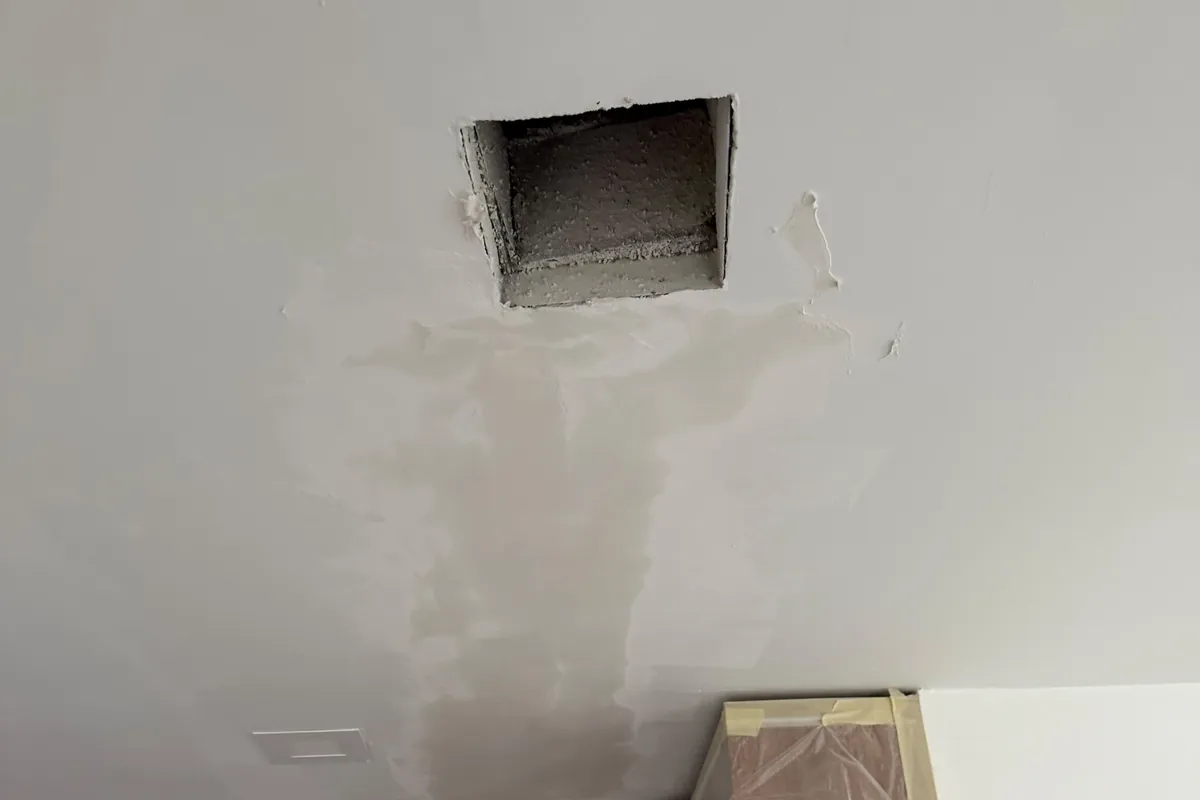
Humid air meeting cold air handlers, ducts and drain lines is a common reason for ceiling stains here, and it is easy to mistake for a roof leak. Roofing and restoration companies in South Florida describe the same clues. A roof leak usually follows rain and tends to follow a single path to one low spot, often near a roof penetration. Condensation tends to be more spread out, can appear on dry days, and may change with how often the AC runs. Stains near vents, ductwork or the air handler point toward the AC.
Neither guess replaces an inspection. A quick attic check by the right trade, a roofer for roof leaks or an AC technician for condensate lines and ducts, tells you where the water came from. We repair the ceiling after the source is fixed. We do not do emergency water extraction or structural drying; see our water damage repair page for how that repair works.
Sagging Ceilings: Why You Should Not Wait
Wet drywall is heavy and weak. A ceiling that sags, feels soft or crumbles is generally cut out and replaced rather than patched, and the insulation above it may be wet too. If a ceiling is bulging, keep people and furniture out from under it and get it looked at promptly. If there is dark growth, it should be assessed before anyone sands or scrapes, since sanding spreads spores.
Popcorn Ceiling Removal and Asbestos Testing
Popcorn texture was common in Florida homes for decades (see our popcorn ceiling removal page if that is the job), and much of South Dade's housing stock falls in that window. The CPSC says asbestos may be present in textured paint and in patching compounds used on wall and ceiling joints, and that their use was banned in 1977. The EPA says material in good condition that will not be disturbed should be left alone, and that testing makes sense when the material is damaged or a renovation will disturb it. Home age is a reason to test, not proof. If you are unsure what your ceiling contains, plan to have the texture tested by an accredited professional before anything is scraped, sanded or drilled, including for lights. If it tests positive, ask a licensed abatement professional what is allowed. Federal asbestos rules for renovation notification generally exempt single-family homes, but condos and multi-unit buildings can be treated differently, so ask before any work in those. Our popcorn ceiling removal guide walks through the full process, painted-over ceilings and finish options.
Ceiling Repair and Popcorn Removal Cost in Homestead, FL
Popcorn Removal and Refinish
$1 to $6 per sq ft
Typical whole-project totals run $900 to $3,100. Your price depends on square footage, ceiling height, patching and whether testing or abatement is needed. Request a free estimate for pricing specific to your ceiling. Every project is custom.
Popcorn removal and refinish$1 to $6 per sq ft
Ceiling drywall repair, depending on water damage$400 to $1,500+
Asbestos lab analysis, per sample (Florida DEP; consultant fees extra)$20 to $100
Asbestos abatement, if foundQuoted by a licensed professional
Repaint after removal$1 to $3 per sq ft
These ranges are general industry ballparks, shown for education only, not a GXG quote. Every project is custom, so your real price comes from a free estimate.
These are estimates, not a quote, and prices vary with materials, the season and the scope of the work. See our popcorn ceiling removal cost guide and drywall repair cost guide, or call (786) 724-5571. Moving up in price: ceiling height or scaffolding, painted-over texture, hidden water damage, recessed lights, and condo or HOA rules.
Texture, Paint and Finishing
Most homeowners choose a smooth ceiling, which is the cleanest look and the easiest to touch up. A light knockdown or orange peel texture hides small flaws better than dead-flat drywall. For a spot repair, matching the existing texture takes more hand work than sanding flat, and a patch can still flash through paint if it is not primed. We prime and paint the repaired area, and ask for a full ceiling coat if you want an even sheen. In humid weather, compound and primer dry slowly, so extra time between coats is normal. Even a good smooth ceiling can show seams under light from a window, and that is normal for older drywall.
Recessed Lights and Attic Checks
When a ceiling is being repaired or refinished, it is a practical time to plan lighting, because holes are cut before the final skim and paint. Wiring and new circuits should be done by a licensed electrician and generally need a permit in Miami-Dade, so lighting is quoted separately. Before closing up any opening, ask whoever is working above the ceiling to look in the attic for wet insulation, stained decking, sweating ducts and a clean condensate line. It is a cheap check that can prevent repeating the job.
Local Context: CBS Homes, Humidity and Permits
Many South Dade homes are concrete block (CBS) construction with drywall ceilings below a roof deck and attic, and our hot, humid climate keeps AC systems working hard. That combination is why condensation, slow drying and recurring stains are such common topics here. After hurricane season, ceiling damage from wind-driven rain or roof openings is a frequent reason homeowners call; the roof should be made watertight first.
On permits, Miami-Dade lists painting as work that does not need a permit and treats minor drywall repair as generally exempt under the Florida Building Code, but Miami-Dade has many municipalities, each with its own building department, while unincorporated areas go through the county permitting office. Electrical work, structural changes and larger projects can change the answer, so ask your building department. Condos and HOAs often add rules on work hours and insurance.
When Ceiling Repair Is the Wrong Fix
- The leak is still activeNew paint will stain through. Fix the roof, plumbing or AC first.
- The drywall is soft or saggingPatching is not enough; the board needs to be replaced.
- You see dark growth or a musty smellHave it assessed before sanding or scraping.
- Cracks are long, widening or paired with sticking doors: ask for an evaluation of the cause before cosmetic work.
- The texture is old and untestedTest first, do not scrape or drill to find out.
- The problem is an AC drain line or ductAn AC technician, not a painter, solves it.
Questions to Ask Any Contractor
- Where do you think the water came from, and who is confirming it?
- Will you replace the drywall or patch it, and why?
- Is asbestos testing needed before you touch this texture?
- Is lighting, painting and cleanup included, and what is itemized?
- How do you protect floors and contain dust?
- What happens if the stain or crack returns?
- Do you pull a permit when one is needed? Check any Florida contractor's license for free at myfloridalicense.com.
- Is the final payment due after the walkthrough?
Our Process
- Free in-home estimate and look at the damage
- Source of any moisture confirmed and fixed first
- Asbestos testing first for older texture
- Cut out damaged board, or patch, tape and compound
- Sand, prime and finish with smooth or matched texture
- Final walkthrough, ready for paint
Frequently Asked Questions
Why is there a brown stain on my ceiling when it has not rained?
In South Florida this is often condensation, not the roof. Cold air handlers, ducts and drain lines in the attic or ceiling space sweat in humid weather, and a clogged condensate line can drip onto the drywall. A useful clue is timing: a roof leak tends to show up with rain, while an AC problem tends to change with how often the system runs. Either way, the source has to be found before the ceiling is repaired, or the stain comes back through new paint.
Can a sagging ceiling be repaired, or does it have to be replaced?
If the drywall is soft, sagging or crumbling, it is usually cut out and replaced rather than patched, because wet board loses its strength. A sagging ceiling can also be holding trapped water, so do not poke it while standing under it, and keep people out of the room until it is checked. Firm, dry drywall with only a stain can often be sealed, patched and repainted. We look at it in person before saying which one you have.
How much does ceiling repair cost in Homestead, FL?
As a general industry ballpark, not a GXG quote, it depends on the size of the damage, ceiling height and finish. As a guide from our drywall repair guide, ceiling repairs commonly run $400 to $1,500 or more depending on how much water damage there is, and popcorn removal commonly runs $1 to $6 per square foot. These are estimates, and prices vary with materials, season and scope. We give you a written estimate after seeing the ceiling. Every project is custom, so your real price comes from a free estimate.
Do I need asbestos testing before removing a popcorn ceiling?
As a general industry ballpark, not a GXG quote, if the home is older, testing first is the careful move. The U.S. Consumer Product Safety Commission says asbestos may be present in textured paint and in patching compounds used on wall and ceiling joints, and that their use was banned in 1977. Age is a reason to test, not proof either way. The EPA says sampling should be done by an accredited professional, and that taking samples yourself is not recommended. Do not scrape, sand or drill the ceiling while you wait for results. Florida DEP cites roughly $20 to $100 per sample for lab analysis, with consultant fees extra. See our popcorn ceiling removal guide for the full breakdown. Every project is custom, so your real price comes from a free estimate.
Why do cracks keep coming back in my ceiling?
Hairline cracks along seams often come from movement or from tape that was not embedded well, and humidity swings can contribute. A crack that returns in the same place after a repair is a sign to look at the cause: a long straight crack, a crack that widens, or one with a stain beside it needs a closer look than a cosmetic patch. Ask any contractor what they will do differently to keep it from reopening.
Can you add recessed lights while repairing or finishing the ceiling?
The ceiling is already open and being finished, so it is a convenient time to plan lighting. The electrical work itself should be done by a licensed electrician and generally needs a permit in Miami-Dade, so it is quoted separately from the drywall and finishing. We coordinate the ceiling work around it so you are not cutting into a finished ceiling later.
Do I need a permit for ceiling repair in Miami-Dade?
Miami-Dade lists interior and exterior painting as work that does not need a permit, and minor drywall repair is generally exempt under the Florida Building Code, but rules differ by city. Miami-Dade has many municipalities with their own building departments, and unincorporated areas are handled by the county permitting office. Electrical work such as new recessed lights generally does need a permit, and structural changes or replacing large areas can change the answer too. Ask your building department, since it has the final word for your address.
Can I just paint over a water stain on my ceiling?
Not with ordinary paint. Once the leak is fixed and the ceiling is fully dry, the stain is usually sealed with a stain-blocking primer, often an oil or shellac based one, before the finish coat, because regular water-based paint can let the stain bleed back through. If the source is still active or the drywall is soft, priming is not the fix. Sealing the stain is also not a substitute for finding the water source.
Who do I call first for a ceiling leak?
Start with whoever owns the likely source. A roofer for a leak that follows rain, a plumber if a pipe or fixture above is suspected, and an AC technician for sweating ducts or a clogged condensate line. A ceiling repair contractor can help you read the clues, but the ceiling is the last step, after the source is fixed and the area is dry.
Does homeowners insurance cover a damaged ceiling?
It depends on your policy and on what caused the damage. Policies commonly treat sudden, accidental water damage differently from long-term seepage, wear or maintenance problems, and the deductible may exceed a small repair. Take photos before anything is changed, and call your insurer to ask before starting work. We cannot say what your policy covers.
Is it safe to live with a popcorn ceiling?
The EPA says material in good condition that will not be disturbed should be left alone, and that exposure happens when material is damaged or disturbed. If your popcorn texture is intact, there is no rush to remove it. Testing is worth doing if it is crumbling or you plan to remodel, install lights or remove it.
Can I repair a ceiling myself?
Small cracks and nail pops are a reasonable DIY job for many homeowners. Water-damaged, sagging or textured ceilings are harder because they involve overhead work, matching texture and finding the cause of the damage, and an older textured ceiling should be tested before it is sanded or scraped. If you are unsure, get an estimate before starting.
Call (786) 724-5571 or request a free estimate to get started. Related reading: popcorn ceiling removal cost and process, drywall repair cost, water damage repair and drywall repair and installation.

Our testimonials say
What Homestead Homeowners
Are Saying
5.0 out of 5, based on 10 reviews
"GXG Remodeling repainted our whole exterior and it held up perfectly through the first rainy season. Clean job site, showed up on time every day."


"We had our kitchen cabinets painted instead of replaced and they look brand new. Saved us thousands and the crew was professional start to finish."

"Fast, honest, and the price matched the written estimate exactly. Would call GXG again for our next project."

"Professional from the first call to the final walkthrough. Our home looks brand new."
"Great communication throughout the whole project and the crew cleaned up every day before leaving."
"Would recommend GXG to anyone in Homestead looking for quality work at a fair price."