
Quartz vs Granite vs Porcelain Countertops for Florida Homes
Excellent on 
★ 5.0 out of 5 based on 15 reviews
- Countertops
-
GXG Remodeling

-
13 Nov 2026
Quartz vs Granite vs Porcelain Countertops for Florida Homes
Short answer: for an indoor kitchen in South Florida, quartz is the easiest to live with, granite is the toughest on heat and is natural stone, and porcelain is the one most often recommended when the counter will sit in sun and weather. The catch is that standard quartz is not meant for outdoor use, and every material has a different weak spot, so the right pick depends on where the counter goes and how you cook. Below is how they compare on heat, stains, sealing, sun, weight, edges, safety and cost, plus what to ask before you sign. Costs are reported ranges from named sources, not GXG quotes.
Quartz, Granite and Porcelain at a Glance
- QuartzEngineered stone made mostly of ground quartz bound with resin. Non-porous, no sealing, consistent patterns. Dislikes hot pans and strong sun.
- GraniteNatural quarried stone. Each slab is different. Handles heat well, is porous, and benefits from sealing.
- PorcelainFired clay slab, thin and hard. Handles heat and UV well and does not need sealing. Edges can chip, and fabrication takes skill.
None of the three is bad. People get unhappy when a material is placed where its weak spot gets tested every day: hot pots beside a quartz range, an unsealed light granite by the sink, or standard quartz on a sunny patio.
What Each Material Actually Is
Quartz countertops are engineered. Product pages and stone suppliers describe them as roughly 90 percent or more ground quartz, with resin and pigment making up the rest. The resin is why quartz is non-porous and why it reacts to heat and UV differently from stone. Cambria, for example, says its surfaces need no sealing, polishing or reconditioning.
Granite is quarried and cut into slabs, so no two are alike, and the slab you pick at the yard is the one you get. Porcelain slab is made from clay and minerals fired at very high temperature into a thin, dense sheet. It is not the same as porcelain floor tile, even though both are called porcelain.
One more name to know: quartzite is a hard natural stone, often chosen for a marble look, and it is not the same thing as quartz. It comes up in showrooms and is often confused with quartz.
Heat, Stains and Sealing
- HeatGranite is described by suppliers as dense and heat-resistant. Cambria says porcelain is resistant to heat. Cambria and Caesarstone both tell owners to use a trivet or hot pad with quartz, because the resin can be damaged by hot cookware. Use a trivet on all three anyway: it protects granite's sealer and avoids thermal shock to any slab.
- StainsQuartz and porcelain are non-porous, so wine, coffee and oil stay on top. Granite is porous, so an unsealed or worn-sealer top can darken under oil or citrus. Dark granites tend to be less thirsty than light ones, and some are resin-treated at the factory, so ask what you are being sold.
- SealingQuartz and porcelain: none. Granite: periodically. Stone care sources differ on the water test, from a few minutes to half an hour of darkening, so rely on your fabricator's guidance for your slab rather than a rule of thumb.
- CleaningCaesarstone warns against oven and grill cleaners, strong acids and alkalis, and similar harsh products on quartz. Mild soap and water is the safe default for all three.
Sun, UV and Outdoor Kitchens
This is where Florida changes the answer. Quartz resin can discolor under prolonged UV, which installers report as yellowing, and manufacturers generally position standard quartz lines for indoor use. Caesarstone, for example, lists outdoor installations as outside the standard indoor warranty and sells a separate outdoor collection with its own warranty terms. Cambria's own FAQ does not address outdoor use, so call the brand and get it in writing for the exact product. That is attributed advice, not a promise about any specific slab.
For uncovered outdoor kitchens, fabricators and suppliers most often name granite, porcelain and properly finished concrete. Standard Supply and Lumber calls porcelain its top recommendation for UV resistance and low upkeep, and AP Advanced lists granite, porcelain and finished concrete as workable in Florida. Even porcelain is not perfect: Cambria's comparison page notes prolonged exposure may lead to fading over time, so ask your supplier what the manufacturer warrants.
Planning one? Our outdoor kitchen page covers layout, utilities, permits and weather-rated materials. Also ask how an outdoor top is anchored and how its edges and seams are sealed, because rain and wind load work on it every season.
What Published Sources Report on Cost
Prices overlap heavily, and slab grade, edge, cutouts and removal change the total more than the material name. These are reported ranges per square foot installed from the named sources, plus a general industry ballpark for a typical kitchen. They are estimates, not quotes, and they vary with materials, season and scope.
Quartz (HomeGuide, porcelain comparison page)$50 to $150
Porcelain (HomeGuide)$40 to $120
Granite (HomeGuide, quartz vs granite page)$80 to $150
Quartz, Miami guide (as cited on our countertop page)$60 to $120
Quartz and granite (Ranney Blair, a remodeling firm's blog, Oct 2026)$105 to $185 and $95 to $225
Typical kitchen countertop job (market ballpark)$2,000 to $8,000
These ranges are general industry ballparks, shown for education only, not a GXG quote. Every project is custom, so your real price comes from a free estimate.
Our countertop installation page shows the same Miami quartz figure and a 40 to 50 square foot kitchen at about $2,400 to $6,000 for basic to mid-range slabs, with premium slabs and waterfall edges costing more. For how the countertop fits into the whole budget, see our kitchen remodel cost guide. Fabricator guides also report that thicker 20 mm porcelain can cost noticeably more than 12 mm, so ask for the thickness on the quote.
Weight, Seams, Edges and Slab Sizes
Weight: a fabricator guide puts 3 cm granite or quartz at roughly 18 to 20 pounds per square foot and 2 cm at around 12 to 13, and notes stock cabinets are built for lighter tops. Sink bases deserve special attention because the cutout removes support. Ask the installer to check that cabinets are level and sturdy before ordering. We check that cabinets are sturdy and level before anything is ordered. If you are replacing cabinets too, see our kitchen remodeling page.
Slab size and seams: Cambria lists a standard quartz slab at 122 by 55.5 inches and a jumbo at 132 by 65.5, in 1, 2 and 3 cm thicknesses. Your kitchen layout decides how many seams you get, so ask to see the seam layout before the stone is cut. Granite varies slab to slab, so seams need pattern matching. Porcelain is often used with 12 mm slabs and mitered edges to build a thicker look.
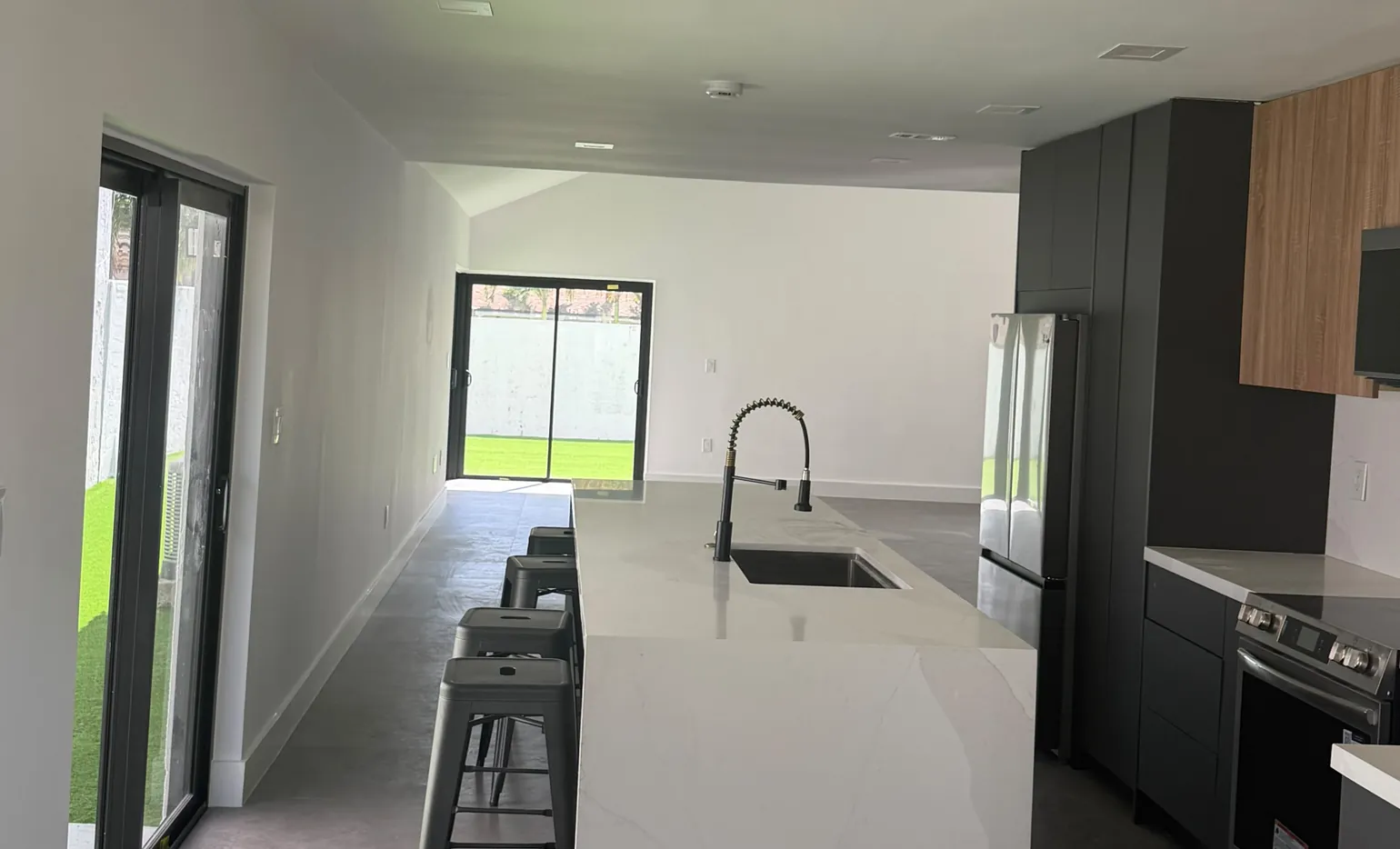
Edges and waterfalls: quartz offers more edge profiles, and Cambria says quartz chips can typically be repaired while porcelain chips often cannot, since porcelain is more brittle at edges. A waterfall edge means extra cuts, matched veining and more cost, and a quality fabricator will handle it carefully. Ask about the finished edge you are getting, not just the top surface.
Silica Dust and Radon: What to Know
Silica: cutting stone creates dust, and OSHA has published a hazard alert on silica in stone countertop fabrication. Engineered stone contains much more crystalline silica than natural stone, which is why OSHA has focused on it. For homeowners this is mainly a question about the shop and the install crew: ask how they control dust, including wet cutting and respirators. A finished, installed top is not the same exposure as cutting it.
Radon: granite is natural stone and some contains trace uranium. In July 2008 the EPA said granite can emit some radon but that it had no reliable data to conclude that the types of granite used in countertops significantly increase indoor radon, and that soil gas is the main source in homes, as reported by Stone World. That statement is more than ten years old, so check the EPA's current radon pages. The sensible step for any home is an inexpensive radon test, not a reason to rule granite in or out.
South Miami-Dade Homes: What Changes Here
- HumidityNon-porous quartz and porcelain shrug off moisture. Granite is fine here too when sealed and when the cabinets under it stay dry. Keep the sink-base area free of slow leaks regardless of the top.
- CBS block and stuccoMany Homestead and South Dade homes are concrete block with slab floors. Slab floors and block walls are rarely perfectly flat, so cabinets can be slightly off level, and a rigid stone top shows it. Shimming and checking level before templating prevents rocking, cracked seams and gaps at the backsplash.
- Outdoor tops and windOutdoor kitchens are exposed to sun, rain and hurricane-season wind. Ask how the top is secured and sealed. Covered structures such as roofs and pergolas are permitted separately; see our outdoor kitchen page.
- Condos and HOAsMany associations want approval before work, with limits on hours, elevators and deliveries. Ask early, because heavy slabs need a delivery plan.
- Flood zones and lead timesIf your home is in a flood zone, ask about cabinet box material as well as the top. Slab availability and delivery can slow during hurricane season, so confirm dates in writing.
Related reading: our cabinet refacing vs painting guide (replacing cabinets almost always means new countertops, while refacing keeps the existing tops), and our tile installation page for backsplashes. If a stucco wall or exterior finish is part of an outdoor kitchen plan, see our exterior painting page.
Questions to Ask Any Contractor
- Which exact slab and thickness?Ask to see the actual slab or a photo of it, with brand, color name and thickness written on the quote.
- Is it rated for where it will go?Get the manufacturer's written warranty for indoor use, or outdoor use if that is the plan.
- Where do the seams fall?Approve the seam layout before the stone is cut.
- What is included?Tear-out, haul-away, sink and faucet reconnection, edge profile, cutouts and backsplash as separate lines.
- Are my cabinets ready?Ask who checks level and support, especially at the sink base and island.
- How is dust controlled?Ask about wet cutting and cleanup for engineered stone and porcelain.
- What is the timeline?Template date, fabrication time and install date in writing, with a note on delays.
- What if something is wrong?A bad template, chipped edge or wrong cutout should have a clear remedy.
- Who pulls permits?Plumbing or electrical changes usually need one. Confirm it with your building department.
You can look up any Florida contractor for free on myfloridalicense.com before you hire.
Frequently Asked Questions
Is quartz or granite better for a kitchen in Florida?
Neither wins everywhere. Quartz is non-porous and does not need sealing, which makes daily life easier in a humid climate. Granite handles heat better and is natural stone with real variation, but it is porous and benefits from periodic sealing. For an indoor kitchen, many homeowners choose on look and upkeep. For anything in direct sun, granite or porcelain is the safer starting point.
Does quartz turn yellow in the sun?
Quartz is held together with resin, and installers and stone suppliers widely report that standard indoor quartz can discolor with prolonged UV exposure. Manufacturers generally point you to indoor use for standard lines and, in some cases, sell a separate outdoor line with its own warranty. Ask the brand for the written warranty on your exact product before putting quartz near a sunny window wall, lanai or outdoor kitchen.
Can I put a hot pan on quartz, granite or porcelain?
Use a trivet with all three. Cambria and Caesarstone both tell owners to protect quartz from hot cookware. Granite and porcelain tolerate much more heat, but a trivet still protects the sealer on granite and avoids thermal shock to any slab, especially near a cutout.
Does granite need to be sealed?
Many granite tops do, and it is usually a simple wipe-on step done periodically. Darker or factory-treated stone may need less. Stone care sources give different water-test timings, so ask your fabricator which sealer they use, how often to reapply, and how to check.
What is the best countertop for an outdoor kitchen in South Florida?
Fabricators and stone suppliers most often recommend dense granite, porcelain slab, or properly finished concrete for uncovered outdoor kitchens, and they steer people away from standard quartz. Ask for the manufacturer's written outdoor rating for the exact product, and ask how the top will be anchored and sealed at the edges.
Is porcelain better than quartz?
It depends on where the counter lives. Porcelain handles heat and sun better and does not need sealing, but its edges can chip and chips are often hard to repair. Quartz is thicker, offers more edge profiles and is more forgiving to fabricate, but it dislikes heat and strong UV. Cambria, a quartz maker, states both of these tradeoffs on its comparison page.
How much do quartz, granite and porcelain countertops cost installed?
Published ranges overlap a lot. HomeGuide reports about $50 to $150 per square foot installed for quartz and $40 to $120 for porcelain, and about $80 to $150 for granite. A Miami quartz pricing guide reports $60 to $120. These are reported market ranges, not GXG quotes. Slab choice, edges, cutouts and removal move the total more than the material category.
Is granite countertop radon a real concern?
In 2008 the EPA said that granite can emit some radon but that it had no reliable data to conclude that granite used in countertops significantly raises indoor radon, and that soil gas is the main source of radon in homes. The practical step is the same for any home: test the indoor air for radon with a test kit or a professional.
Do I need a permit to replace countertops in Miami-Dade?
Swapping countertops on existing cabinets generally does not need a permit. Moving plumbing, adding electrical or changing the layout can. The building department that covers your address has the final word, and condo or HOA buildings often have their own approval and work-hour rules.
How long does it take to get new countertops?
The install itself is often a day. The wait is between template and install, because the slab is cut to your measurements. Our kitchen cost guide notes fabrication often takes about a week or more after templating, and slab availability and hurricane season can stretch that. Get the timeline in writing when you choose the slab.
The best countertop is the one that fits how you cook and where it will live, and the only reliable price comes from someone measuring your kitchen and seeing your slab. If you are comparing materials, see our countertop installation page or call (786) 724-5571 for a free, no-obligation written estimate.

Our testimonials say
What Homestead Homeowners
Are Saying
5.0 out of 5, based on 15 reviews
"GXG Remodeling repainted our whole exterior and it held up perfectly through the first rainy season. Clean job site, showed up on time every day."


"We had our kitchen cabinets painted instead of replaced and they look brand new. Saved us thousands and the crew was professional start to finish."

"Fast, honest, and the price matched the written estimate exactly. Would call GXG again for our next project."

"Professional from the first call to the final walkthrough. Our home looks brand new."
"Great communication throughout the whole project and the crew cleaned up every day before leaving."
"Would recommend GXG to anyone in Homestead looking for quality work at a fair price."